🌏 Why Asia Needs an Asian Union: A Vision for Peace and Power
Explore the vision of a united Asia through the concept of an Asian Union—modelled after the European Union. This blog dives into the root causes of conflicts in Asia, compares them with peaceful regions like South America, and outlines how a regional alliance could bring lasting peace, economic growth, and independence from foreign interference.
INTERNATIONAL POLITICS
6/27/20255 min read
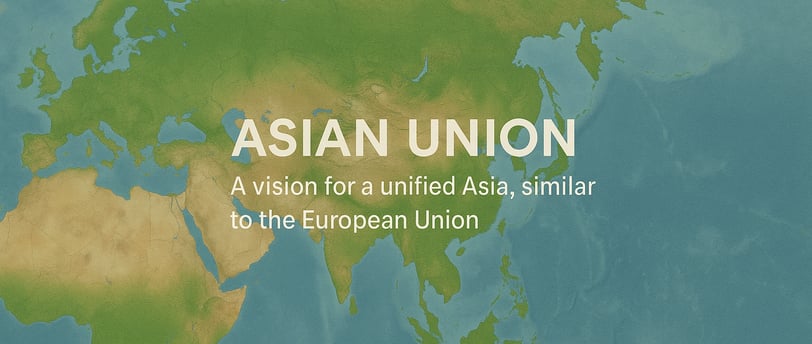
Across the globe, Asia remains one of the most dynamic yet troubled regions. From the ongoing tension in the Middle East to long-standing rivalries in South and East Asia, the continent continues to be shaped by conflict, foreign interference, and fragile diplomatic relationships. In stark contrast, regions like South America have remained relatively peaceful, with fewer wars and more cooperative engagement. This raises a profound question: Can Asia solve its own problems by coming together — politically and economically — like Europe did through the European Union?
The concept of an Asian Union may seem ambitious, but it offers a powerful vision of unity, self-reliance, and long-term peace. This article explores the reasons behind Asia’s persistent instability, compares it with other regions, and presents a realistic model of how an Asian Union could function.
🔥 Why Is Asia Plagued by Conflict?
One of the defining features of modern Asia is the frequency of conflict, whether it's territorial, ideological, or religious. These conflicts are not random. They are deeply rooted in the historical, colonial, and geopolitical landscape of the region.
Firstly, the legacy of colonialism has had a lasting impact. After World War I and II, European powers such as Britain and France drew borders in the Middle East and South Asia with little regard for the ethnic, religious, or tribal realities on the ground. This led to unnatural divisions and set the stage for conflicts like the Israel–Palestine issue or the India–Pakistan partition. The consequences of those lines on the map continue to be felt today.
Secondly, Asia is home to a rich tapestry of religions and cultures — including Islam, Hinduism, Buddhism, Christianity, and countless ethnic groups. While this diversity is a strength, it can also lead to tension, especially when exploited by political leaders. Sectarian conflicts in places like Iraq, Syria, and Myanmar are fueled not just by ideology but by power struggles and historical grievances.
Furthermore, Asia contains some of the most militarized and volatile borders in the world. Whether it's the India–China border in the Himalayas, the Taiwan Strait, or the Korean Peninsula, unresolved disputes and national pride often escalate tensions. These rivalries are deeply embedded in the region's identity, making peace difficult to achieve without a cooperative framework.
🌐 The Role of Foreign Powers
Western nations have played a significant and often controversial role in Asian conflicts. During the Cold War, the U.S. and the Soviet Union turned many Asian nations into proxy battlegrounds — most notably in Afghanistan, Vietnam, and Korea. Even in the post-Cold War era, interventions by the United States and NATO in Iraq, Syria, and Afghanistan have left deep scars, often worsening the situations they aimed to improve.
Foreign powers have also backed military coups, supported authoritarian regimes, and funded opposition groups — depending on what suited their strategic or economic interests. Arms sales, oil pipelines, and access to trade routes are often the hidden motivations behind such involvements. While Western countries claim to support democracy and peace, their actions in many cases have prolonged conflict rather than resolved it.
🕊️ Why Is South America More Peaceful?
Interestingly, South America, which was also colonized by European powers, does not suffer from the same level of ongoing warfare. While it faces internal problems such as corruption, drug trafficking, and poverty, it has largely avoided state-to-state wars in recent decades. This is partly due to its cultural and religious homogeneity (mostly Christian and Spanish/Portuguese speaking) and the lack of major ideological or territorial disputes.
Moreover, South America has fewer external military entanglements and a more cooperative approach to regional diplomacy. Countries like Brazil, Argentina, and Chile often resolve differences through dialogue and regional platforms, rather than armed conflict. This proves that peace is possible, even in regions with a troubled past — provided the focus is on cooperation over confrontation.
✊ The Case for an Asian Union
Given the challenges faced by Asia — both internal and external — the idea of forming an Asian Union emerges as a strategic and visionary solution. Much like the European Union brought peace to a war-torn continent, an Asian Union could help resolve conflicts, reduce foreign interference, and promote regional prosperity.
The Asian Union would be a political, economic, and cultural alliance — not aimed at erasing national identities, but rather at creating a platform for cooperation. It would involve the creation of core institutions such as an Asian Council (for leadership summits), an Asian Parliament (for legislative coordination), and an Asian Court of Justice (to resolve disputes peacefully). A central administrative body, or Asian Secretariat, could handle day-to-day operations.
💱 Economic Integration and Growth
One of the main pillars of the Asian Union would be economic cooperation. Member countries could form a free trade zone, eliminating tariffs and encouraging regional trade. This would benefit both large economies like China and India, and smaller nations like Nepal or Cambodia, by creating new markets and reducing dependency on Western economies.
Eventually, the Union could consider a digital or shared currency — starting perhaps with currency swaps or a common digital payment system. A new Asian Development and Innovation Bank could be established to invest in infrastructure, green energy, education, and digital transformation — areas crucial for Asia’s future.
🛡️ A Framework for Peace and Security
Peace is not just the absence of war — it’s the presence of trust, mechanisms for conflict resolution, and joint responsibility. The Asian Union could introduce a Peace Charter, requiring all members to resolve disputes through dialogue and not war. An Asian Security Council could monitor high-risk zones like Kashmir, the Taiwan Strait, or the South China Sea, while a joint peacekeeping force could intervene in humanitarian crises.
In the age of digital threats, cooperation in cybersecurity and counterterrorism would also be essential. A united intelligence-sharing framework could help neutralize threats before they escalate into violence.
🌐 Celebrating Asia’s Cultural Diversity
An Asian Union wouldn't just be about economics and politics — it would also foster a shared regional identity. A visa-free travel arrangement could allow easier movement for education, tourism, and work. A student exchange program — like the EU’s Erasmus — could encourage younger generations to learn from each other.
To promote pride in the region’s cultural heritage, the Union could establish an annual "Cultural Capital of Asia" title, rotating between cities to showcase the continent's rich traditions, art, music, and cuisine.
🌍 Who Would Join?
The Union could begin with a core group of founding members — such as India, China, Japan, South Korea, ASEAN nations, Iran, and Central Asia. Over time, countries like Pakistan, Bangladesh, the Gulf States, and Sri Lanka could be included. Even observer members like Turkey, Mongolia, or Russia (Asian part) could contribute in specific areas.
Of course, political differences, mutual suspicions, and rivalries would need to be handled through strong diplomatic channels and trust-building initiatives.
🚧 Challenges Ahead
Creating an Asian Union is no small task. The biggest hurdles include:
Historical rivalries (e.g., India–China, India–Pakistan).
Diverse political systems — from democracies to monarchies to communist states.
Fear of domination by powerful countries (like China).
Lack of shared identity or legal standards across the region.
But none of these challenges are insurmountable. Europe overcame centuries of war, including two World Wars, to build a peaceful and cooperative union. Asia, with political will and vision, can do the same.
🌱 Final Thoughts
The Asian Union is more than a dream — it’s a logical and necessary step toward solving the continent’s biggest problems. It would empower Asia to manage its own affairs, reduce foreign control, and bring peace and prosperity to billions of people.
This kind of unity won't happen overnight, but it begins with dialogue, cooperation, and shared vision. If Europe could do it, so can Asia. It’s time to imagine a new future — one where Asia stands united, strong, and truly independent.
© 2025. All rights reserved.